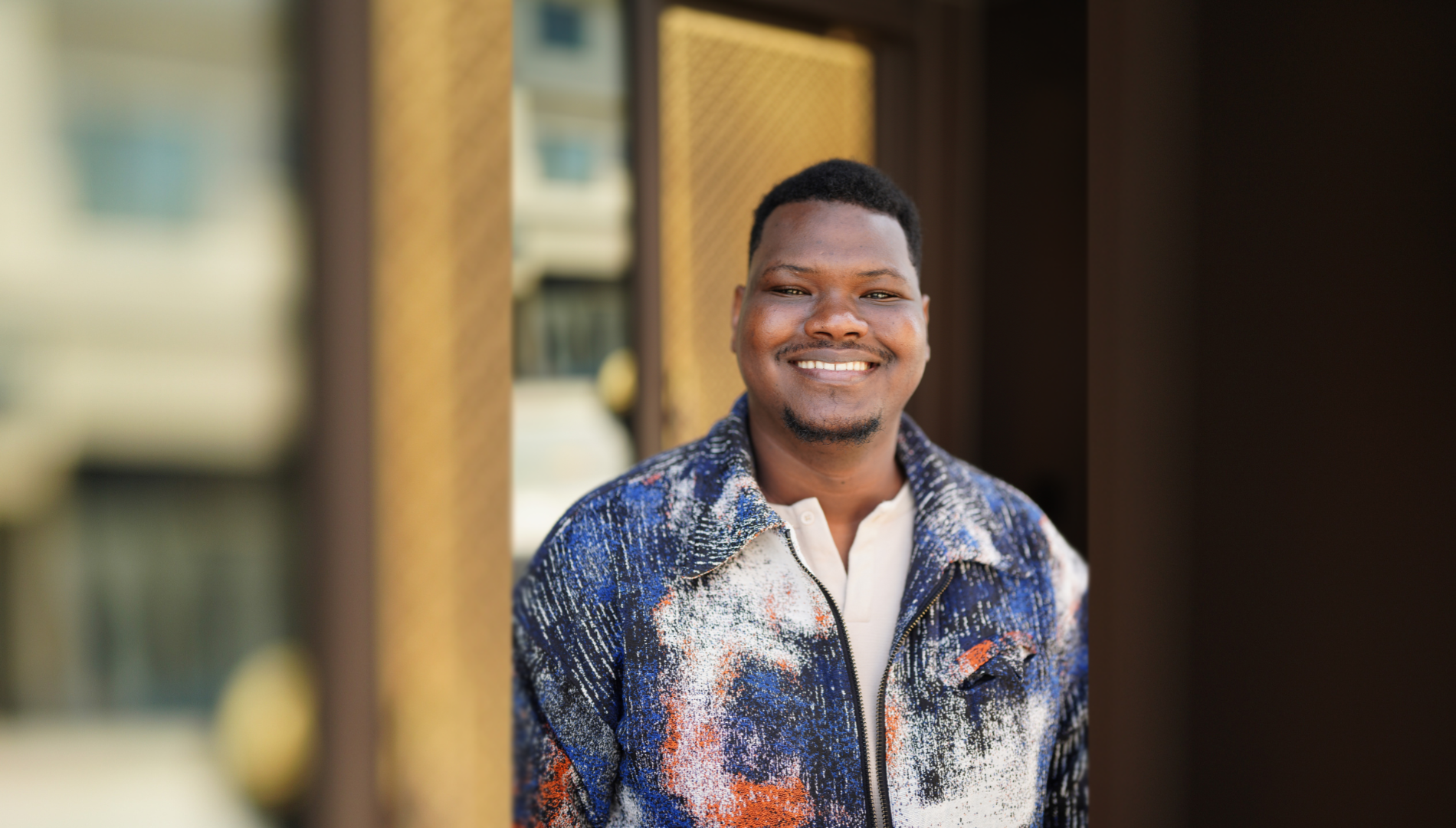
Ph.D. student Mohammed W. Bah awarded APPAM Fellowship
By Matt Coker
For Mohammed W. Bah, a doctoral student in the Department of Urban Planning & Public Policy, the reality of climate change has never been an abstract theory.
Growing up in Monrovia, Liberia, during the Second Liberian Civil War (1999–2003), Bah witnessed severe environmental insecurity firsthand. He watched the ocean swallow homes and entire communities through coastal erosion and flooding — experiences that profoundly shaped his path as a researcher.
Now, Bah has been named a recipient of the prestigious 2026 Association for Public Policy Analysis & Management (APPAM) Excellence, Equity, and Inclusion Fellowship.
“I was incredibly honored to learn that I had been selected,” Bah says. “It is a competitive opportunity and receiving it at this point in my Ph.D. is meaningful. I am entering my third year, a stage when I am further developing my research and thinking more intentionally about the scholarly and policy communities that I want my work to contribute to.”
A milestone for emerging scholars
Launched in 2016, the APPAM Excellence, Equity and Inclusion Fellowship supports students and professionals who have overcome substantial obstacles presented by their backgrounds or life circumstances while pursuing careers in public policy, analysis and management. By sponsoring more than 300 emerging scholars to date, APPAM aims to expand opportunities in the field and foster the next generation of policy leaders.
The fellowship provides full financial support — including conference registration, travel and lodging — for Bah to attend the APPAM Annual Fall Research Conference in Boston this November. There, he will present his research on an academic panel, engage in leadership development and network with leading policy experts.
Bah learned about the fellowship opportunity through his advisor, Associate Professor Nícola Ulibarrí, who encouraged him to apply and provided a letter of recommendation.
“APPAM is particularly valuable to me because it brings together people working across disciplines and policy areas,” Bah noted. “The fellowship is an opportunity to strengthen my research, receive feedback, build relationships with other scholars and practitioners, and bring perspectives from Liberia and the broader Global South into conversations where they are still too often underrepresented.”
Bridging lived experience and policy research
Bah’s academic interest sits at the intersection of climate adaptation, environmental governance and environmental justice. His childhood in Liberia—a nation that contributes minimally to global greenhouse gas emissions yet faces severe climate impacts—drives his focus on equity and representation in policy decisions.
As a first-generation college student, Bah navigated financial, educational and cultural hurdles as he transitioned to undergraduate study at the University of Rochester in New York before coming to UCI.
“My background influences not only what I study, but how I approach research,” he explains. “It has made me especially attentive to whose knowledge counts, whose voices are included in decision-making, and whether policies designed to protect vulnerable communities actually respond to their needs.”
An impressive academic journey
The APPAM Fellowship adds to a growing list of accolades Bah has earned during his graduate studies at UCI, including:
- UCI Community Geoscience Initiative Fellow (2024-2025): Worked alongside the Sacred Places Institute for Indigenous Peoples to examine sea-level rise and the loss of native plants affecting Tongva and Acjachemen lands in Orange County.
- StoryMap Challenge Winner (2025): Named the graduate winner in the Department of Urban Planning & Public Policy for his project “Adapting to Sea Level Rise in the San Francisco Bay Area.”
- John M. Whiteley Fellowship (2026): Received funding for upcoming fieldwork in Grand Gedeh County, Liberia. Working with co-advisors Ulibarrí and Professor Richard Matthew, Bah is investigating climate-induced migration from Burkina Faso into Liberia and how local governance mediates potential land conflicts.
- Dillon Henry Memorial Scholarship Intern: Spent 10 weeks with the Surfrider Foundation focusing on ocean protection, beach access and coastal policy.
Looking ahead, Bah plans to complete his prospectus and advance to candidacy by Winter 2027, with an anticipated Ph.D. completion in Spring 2029.
“Someday, I want to become a scholar whose research does not merely describe policy problems,” he says, “but contributes to more equitable and responsive ways of addressing them.”