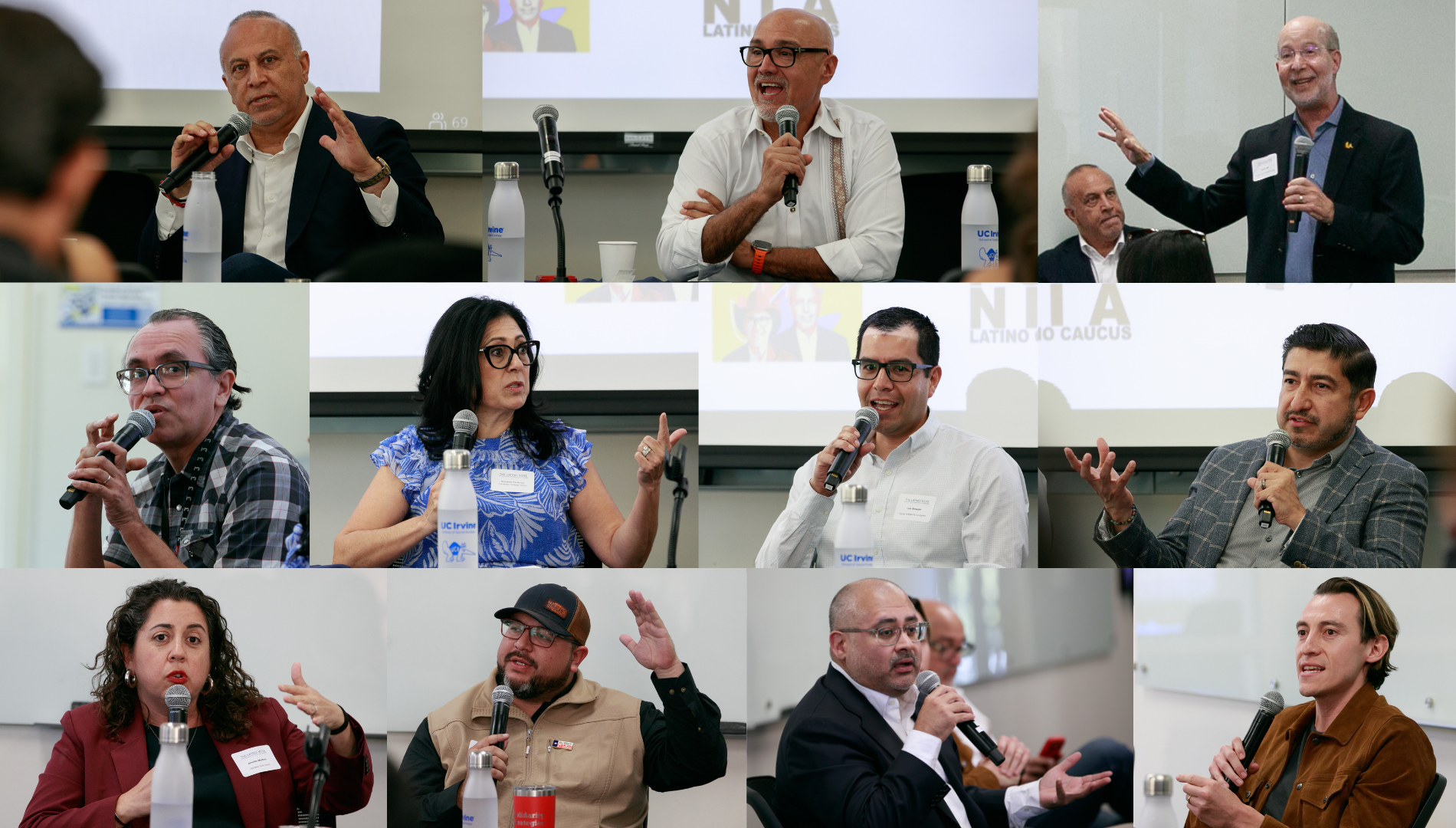
Speakers at the Nov. 9 Latino vote midterm post-mortem held on campus included political strategists and journalists. From left, top row: Mike Madrid, Chuck Rocha and Jon Gould; middle row: Gustavo Arellano, Rosalina Cardenas, Luis Alcauter and Arturo Carmona; bottom row: Jennifer Medina, Abel Prado, Mike Trujillo and Estevan Jose Montemayor. Photos by Han Parker
National midterm election post-mortem shines light on Latino vote significance
By Mimi Ko Cruz
Latino voters helped propel Democrats to a midterm sweep across the country. Now comes the greater responsibility: turning that political power into relief for families struggling with the cost of living, speakers said Nov. 9 at an election post-mortem held on campus.
“I see it as not just a celebration, but a sense of responsibility now,” said Rosalina Cardenas, media director for Xavier Becerra’s winning campaign for California governor. “Engagement is not a three-month strategy; it’s a year-long commitment.”
She warned: “If we do not engage the Latino community, we will lose them.”
The five-hour event, titled “The Latino Vote, MidTerms 2026: A National Post-Mortem,” was presented by UC Irvine’s School of Social Ecology in partnership with The Latino Vote Podcast, the California Latino Legislative Caucus and The Latino Working Class Project. Strategists who ran the campaigns joined reporters who covered them to dissect races in California, Texas and Los Angeles.
Most significant night
Mike Madrid, a Republican-turned-Democratic-ally consultant, author of The Latino Century and a School of Social Ecology senior fellow, called election night (Nov. 3) “undebatably the most significant night in Latino political history.”
Latinos, he said, “will hold the governorship of California and the largest Hispanic congressional caucus ever. California’s Latino legislative caucus will number 55 to 60 of 120 members, while Republicans fall to roughly 16 to 18.”
Madrid said the surge was powered by young Latinos with little or no voting history, a group pollsters rarely survey. That, he said, helps explain why polls missed the size of the wave.
By most accounts, Latino voters “moved sharply to the left,” a notable reversal for a group that had shifted toward President Donald Trump two years earlier. And, Latinos helped shape some of the most competitive House contests.
Madrid and Chuck Rocha, co-hosts of The Latino Vote Podcast, stressed that this is no permanent realignment.
Rocha, a Democratic strategist, said Latino voters are angry and voted mainly over the cost of living. He called the shift a “dealignment,” not a new loyalty.
Pocketbook politics
Madrid said a Latino voter’s pocketbook comes first.
“Do not think for one second that these voters will not go back,” he said, noting that Republicans celebrated what they thought was a “permanent racial realignment” just two years ago.
Rocha said Democrats were rewarded partly because they spent early in targeted districts. His firm produced more than 200 Spanish-language ads focused largely on costs and corruption. He said the Latino shift was 39 points in Texas and more than 45 in the district of Texas Congressman-elect Bobby Pulido.
Pulido’s campaign manager, Abel Prado, said the Rio Grande Valley campaign relied on retail politics. It collected about 14,000 unique positive voter identifications, and about 87% of those voters turned out. About 40% were children of immigrants who had never voted.
Quineañera gold
A quinceañera joke prompted a campaign video that drew thousands of invitations, which Prado said was equivalent to roughly $9,000 in digital spending for a single appearance.
New York Times reporter Jennifer Medina said Trump flags she saw everywhere in the valley had vanished by fall. She called immigration enforcement and economic pain “completely intertwined” there.
In California, Luis Alcauter, who ran Randy Villegas’ campaign, said Villegas, a 32-year-old community college professor, was leading Republican David Valadao by about 30 points in a 74% Latino Central Valley district. That would make him the region’s first Latino congressman.
Cardenas said money mattered less than expected, noting that $80 million was spent against Becerra in the final six weeks.
Arturo Carmona, who led Latino outreach against Proposition 40, the billionaires’ tax measure, said Latinos backed it by a narrow margin while the overall electorate rejected it.
In Los Angeles, strategists described a generational contest.
Councilwoman Nithya Raman was leading Mayor Karen Bass in the count. Pollster Mike Trujillo said an exit poll showed voters of every race who were born after 1975 favored Raman.
Estevan Jose Montemayor, who ran a $12 million independent expenditure supporting Raman, said affordability, disapproval of Mayor Bass and anti-establishment sentiment drove the result.
Los Angeles Times columnist Gustavo Arellano called the midterms “an anti-establishment election,” and said that also meant “anti-machine.”
Madrid cautioned that California still has about 2.5 million ballots to count, so national Latino figures remain incomplete.
An audience member asked what happens now that sons and daughters of immigrants lead California. He noted that the state faces budget troubles and voters expect results.
Madrid said the answer is the one immigrant families have always given: “We pick it up, we don’t make excuses.”
‘Make them deliver’
Rocha closed with a warning for both parties.
“Now they have to come to us,” he said. “Make them deliver, and if they don’t, let’s hold them accountable.”
Social Ecology Dean Jon Gould, who opened and closed the event, said Latinos are not a monolith but are united by shared concerns.
He said that the school’s UCI-OC Poll detected a shift before this year’s election: In 2024, Latino voters were moving away from identification with Democrats, but not necessarily toward Republicans. Many instead identified as independent or no party preference.
Madrid warned that Democrats should not assume this year’s gains will last. Latino voters have been losing faith in both parties, he said, and could change course again if their economic concerns go unanswered.
That’s what students heard.
Carter Luo, a UC Irvine urban studies and public health policy major, said he learned an important lesson from listening to the event’s speakers: “Nothing in politics is forever and everything changes based on how people feel in the moment.”
For Sofia Mercado, a UC Berkeley economics and public policy student who drove seven hours last week to go home to Los Angeles to vote and stayed for “The Latino Vote” event, it was personal.
“I wanted to vote because I’ve seen the impact that the community has been facing with the ICE raids,” the first-generation college student said. “My parents are migrants from Mexico and they were afraid to go to grocery stores and I really wanted to show up and vote because my vote was not just my vote, it was their vote, and coming to this event really solidified my conviction. Latinos are an emerging generation fighting for what’s right and no matter what our politics are, we always fight for the good of our families, our community.”
The event recording is available on YouTube