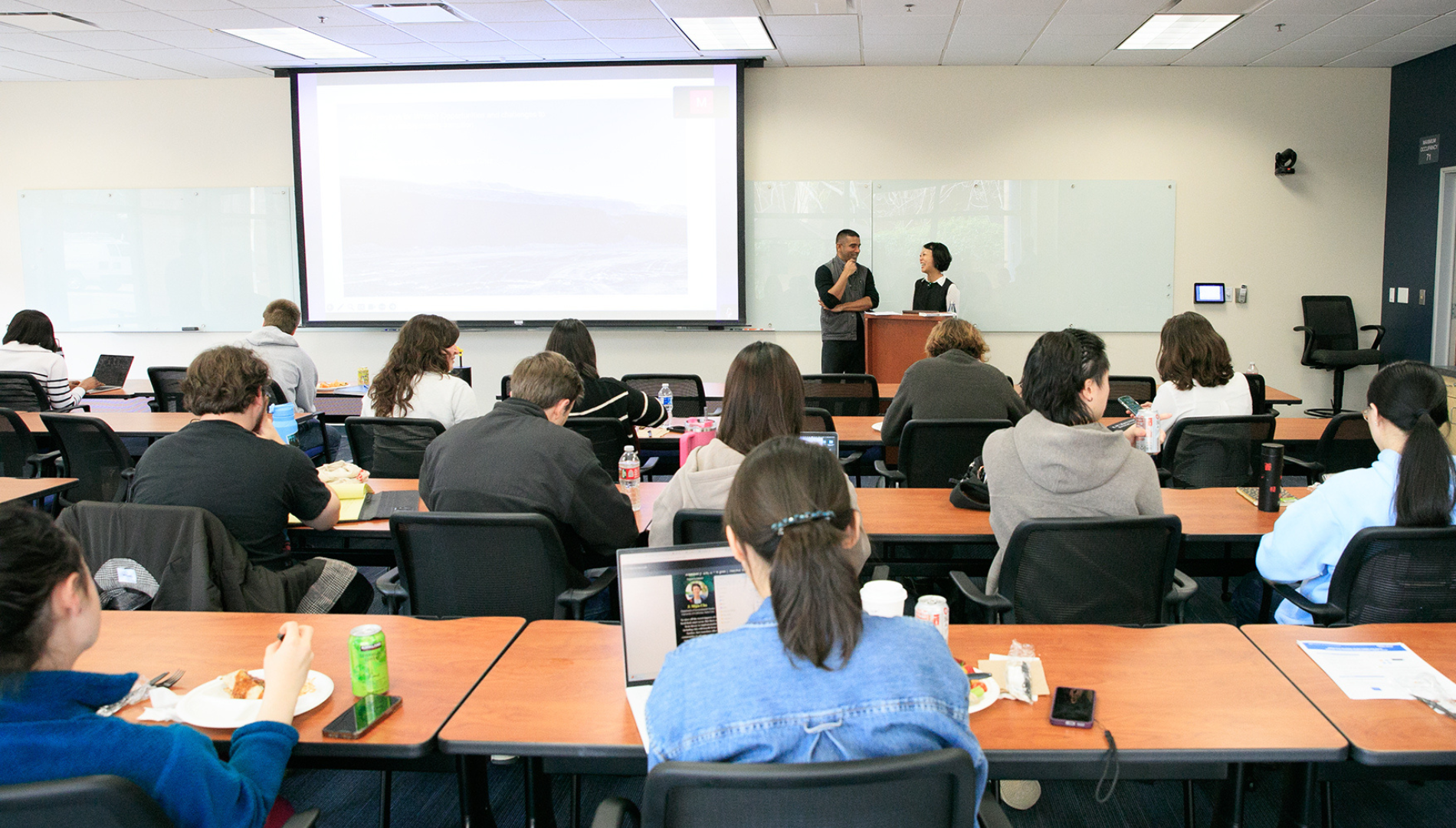
Assistant professors Mukul Kumar of UC Irvine and J. Mijin Cha of UC Santa Cruz chat before her climate justice talk. [Inset]: Assistant Professor Daniel Aldana Cohen of UC Berkeley and Cha at their respective lectures to UCI students. Cha photos by Han Parker and Cohen image by Matt Coker
School joins CUSP and Glasser Center in presenting Climate Justice Lecture Series that epitomizes #AllinforAll
In a context of rising unaffordability and climate change induced disasters, the Climate Justice Lecture Series unpacks the social, economic, and political dimensions of climate change. Master’s and doctoral students in the Department of Urban Planning and Public Policy at UC Irvine are already drawing upon the series to develop interdisciplinary analysis to tackle these complex challenges.
The School of Social Ecology and its Social Impact Hub, the Climate and Urban Sustainability Program (CUSP) and the UC Irvine Alec Glasser Center for the Power of Music and Social Change are co-presenting the series, which features lectures by three leading scholars and practitioners of climate justice from other University of California campuses as well as a fourth speaker from Rhode Island.
 Open to all who RSVP, the lectures are especially directed at enrollees of the graduate-level course “Energy Politics” led by Assistant Professor Mukul Kumar, who introduces each speaker and moderates lively question-and-answer sessions that follow. Advanced Ph.D. students also had the opportunity to participate in a workshop with guest lecturers and Professor Kumar to develop dissertation projects focused on a range of topics, from oil refinery closures to climate adaptation.
The lecture series is critical for Energy Politics students who have been tasked with applying the concepts they learn to local or institutional contexts. This includes connecting research by the lecturers to policy and activism, fostering interdisciplinary dialogues and acquiring the analytical tools necessary to assess climate-related inequities in housing, labor markets, transportation and energy.
Green housing activism
Daniel Aldana Cohen, an assistant professor of sociology at UC Berkeley, kicked off the series Jan. 21 with a lecture titled “Street Fight: Climate, Housing, and Inequality in the 21st Century City.” Cohen not only studies and writes about social housing, the green political economy and whole-community climate mapping, but he also led the research for the Green New Deal for Public Housing championed by Rep. Alexandria Ocasio-Cortez (D-New York) and Sen. Bernie Sanders (I-Vermont).
In his lecture, Cohen drew from events on the ground in two large cities – São Paulo, Brazil, and New York City – to demonstrate how the effects of climate change are changing the green movement from being predominantly driven by elites and the upper middle class to the poor and working class experiencing the brunt of environmental challenges.
However, as Cohen explained, their activism is linked more to housing (or the lack thereof) than elite projects of greening the city. Gentrification of city centers to bring professional commuters closer to their jobs, and thus reduce harmful emissions, means pushing out existing, low-income residents. It’s a double whammy as climate change-induced destruction often damages or wipes out the dwellings of working-class people, who could barely afford to live in them already, let alone pay to repair or rebuild them.
This phenomenon has led to community and climate change activists joining forces to push for “green social housing,” according to Cohen. “Housing is playing a surprisingly central role in blocking and passing low-carbon policies,” he says.
Environmental sociology has concentrated “on parks and greenery, and has not focused so much on carbon, and yet carbon pollution is the root cause of climate breakdown,” Cohen said. “… We need to follow the carbon like follow the money.”
Energy Politics students are using Cohen’s scholarship to draft their own opinion editorials “that analyze the intersections of the housing crises, climate change, and socio-economic inequality,” Kumar says. “These opinion editorials will evaluate the significance of proposals for green social housing that Professor Cohen’s research helped pave the way for.”
Equitable energy
J. Mijin Cha, an assistant professor of environmental studies at UC Santa Cruz, spoke Jan. 28 on “A Just Transition for Whom? Challenges and Opportunities to Advance an Equitable Energy Transition.” Cha testified before a congressional committee in 2023 on ways to create decent, family-sustaining jobs while decarbonizing the economy. A year later, MIT Press published her book A Just Transition for All.
Like Cohen did the week before by linking climate change to housing affordability, and the coalitions that have and should be forming among activists for each, Cha emphasized the need for social and economic justice in the transition away from fossil fuels.
Cha persuasively noted that “climate change and emissions production are the result of extractive systems and institutions, and as such we cannot address the emissions issue without addressing the systematic and institutional issue.” She explained that in her work with labor organizers and coal mine workers in the Powder River Basin, the largest coal producing region in the U.S., transitioning away from fossil fuels can only be thinkable with the provision of healthcare, education and a diversity of good quality jobs. In other words, a “just transition” entails transforming the extractive employment conditions of fossil fuel industries.
Her lecture serves as a jumping off point for a case study by Energy Politics students on a just transition for “historically disadvantaged communities in the low-carbon economy,” Kumar says. “The case study focuses on the efforts of labor unions and civil rights organizations who secured good quality jobs at an electric bus manufacturing facility in Alabama through a community benefits agreement.”
The Climate Lecture Series picks up again April 29 with David Pellow, the environmental activist and Distinguished Professor and Dehlsen Chair of Environmental Studies at UC Santa Barbara, and concludes May 27 with Thea Riofrancos, associate professor of political science at Providence College. Lecture titles and locations will be announced on the School of Social Ecology’s online Events page.
— Matt Coker