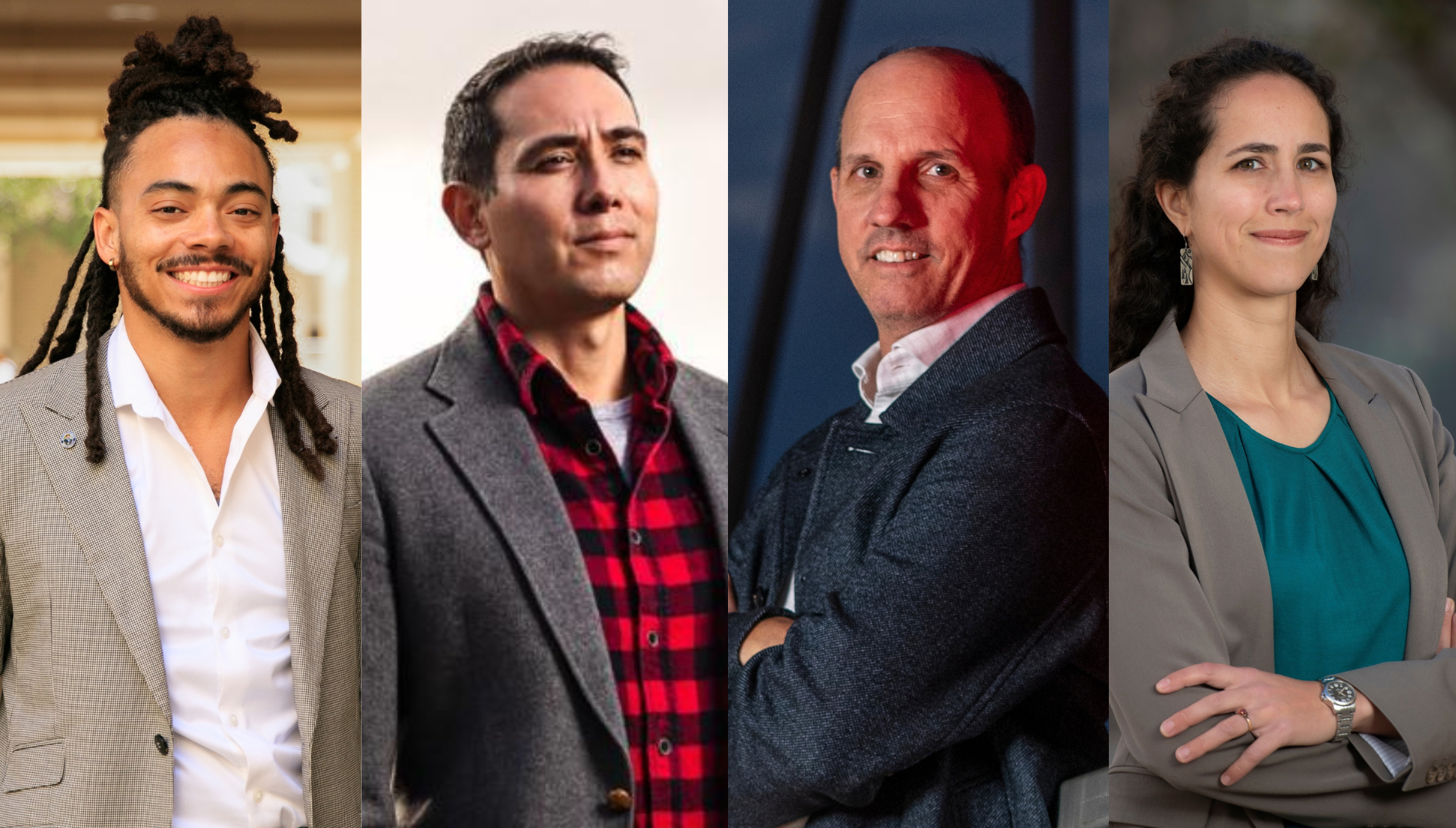
From left: Dominic J. Bednar, Michael Méndez, Brett F. Sanders and Nícola Ulibarrí
UC Irvine faculty among 175 authors of new commentary
By Mimi Ko Cruz
Four University of California, Irvine faculty members are among 175 scientists and researchers who co-authored a sweeping new commentary arguing that the United States must dramatically accelerate how it conducts climate assessments and translates scientific findings into action or risk being overwhelmed by the cascading consequences of climate change.
The paper, “Research priorities for robust climate assessments in the United States,” published simultaneously today in Earth’s Future and in the Bulletin of the American Meteorological Society as the inaugural entry in a joint special collection launched by the American Geophysical Union and the American Meteorological Society. The collection is specifically designed to build a body of assessment-ready science to inform future national and sub-national climate evaluations.
The researchers’ central message is urgent: climate change is accelerating faster than U.S. institutions are responding and the scientific community needs to close that gap quickly.
“As climate change impacts accelerate, the pace of assessment and the integration of science with decision-making and action must accelerate as well,” the authors write.
The last U.S. National Climate Assessment was published in 2023, but the authors argue that climate science has continued to advance, that state, local and private sector assessments are ongoing, and that a more sustained, networked approach to synthesizing and delivering climate science is needed.
Among their findings:
- Compound and cascading climate events, such as a heatwave following a hurricane-induced blackout or wildfires followed by flooding, are increasingly overwhelming systems designed to handle threats in isolation.
- Legacy infrastructure, outdated policies and institutional silos are amplifying exposure and vulnerability rather than reducing them.
- And, greenhouse gas emissions are continuing to alter and amplify hazards across every region and sector studied.
The paper spans 22 topic areas — from oceans, coasts and forests to urban regions, rural communities, agriculture, human health, air quality and energy — and synthesizes the research needs across physical, ecological, social and economic systems.
It also examines the full spectrum of climate responses: mitigation, adaptation and emerging climate interventions such as solar radiation management and carbon dioxide removal.
Addressing equity issues
The paper documents how historically marginalized communities, including Indigenous Peoples, communities of color, low-income households and rural populations, bear disproportionate climate burdens, and argues that future assessments must grapple more explicitly with those inequities, not treat them as secondary concerns. Its authors say the paper functions as a roadmap for future collaborations between academic institutions, governments, Indigenous Peoples, the private sector and communities to advance research that is timely, actionable and equitable.
UCI’s four contributing researchers each brought distinct expertise to the effort.
Dominic J. Bednar, UCI assistant professor of urban planning and public policy, contributed to the paper’s mitigation section, particularly on the importance of community engagement and community-based research for climate mitigation efforts.
“It is understood that low-income, Black, brown, and indigenous communities are hit first and worst by the effects of climate change,” he said. “Community engagement and community-based research are vital pathways to more inclusively ensure climate mitigation, particularly regarding the energy transition and decarbonization efforts.”
Michael Méndez, UCI associate professor of urban planning and public policy, contributed to the social systems and environmental justice dimensions of the paper, including how race, history and structural inequality shape who bears the burden of climate impacts and who benefits from climate action.
“Centering environmental justice in climate assessment reports will ensure that they inform actionable, relevant, and accessible climate change science and policy responses,” Méndez said.
Nícola Ulibarrí, UCI professor of urban planning and public policy, contributed to the paper’s adaptation section, particularly on decision-support tools and the policy mechanisms that help — or hinder — communities in choosing how and when to act on climate risk.
“Communities across the U.S. are changing where and how they live, building new infrastructure and updating their behavior to protect themselves against climate change,” Ulibarrí said. “But we need better, more comprehensive evaluation of those adaptations to know what works, for which types of people and places, to ensure that communities are actually protected against climate impacts.”
Brett F. Sanders, UCI professor of civil and environmental engineering, contributed expertise on coastal and urban flood risk.
His recent research on large and inequitable flood risks across Los Angeles helped inform the paper's findings on compound coastal hazards and the systemic economic risks that extend far beyond the waterline, including effects on insurance markets, municipal finances and housing values.
“It can be challenging to imagine the risks of major flooding in a place like Los Angeles, where the sun is shining and the skies are clear most of the time,” Sanders said. “But, with a major El Niño winter ahead of us, it becomes increasingly important that communities prepare.”