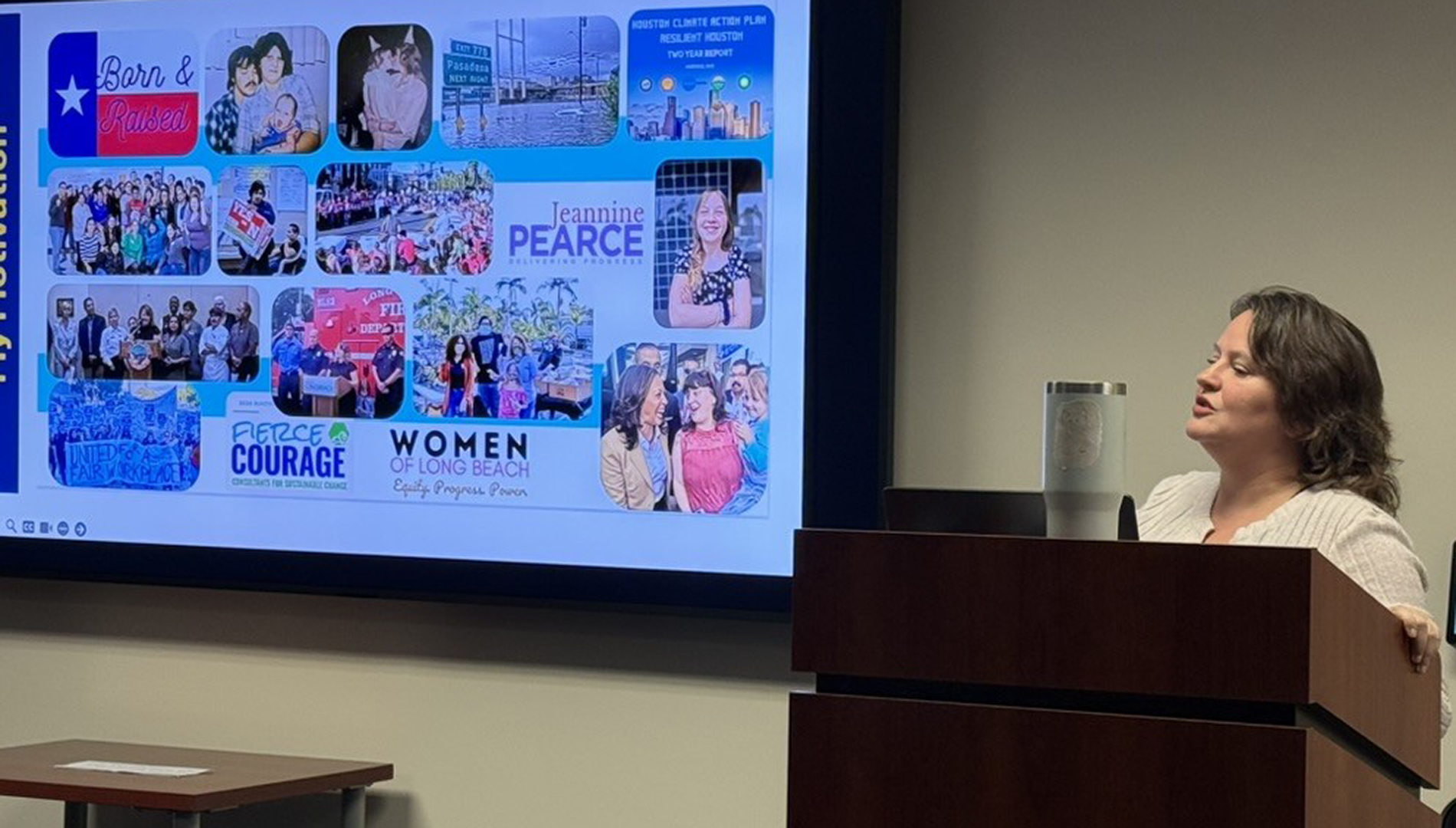
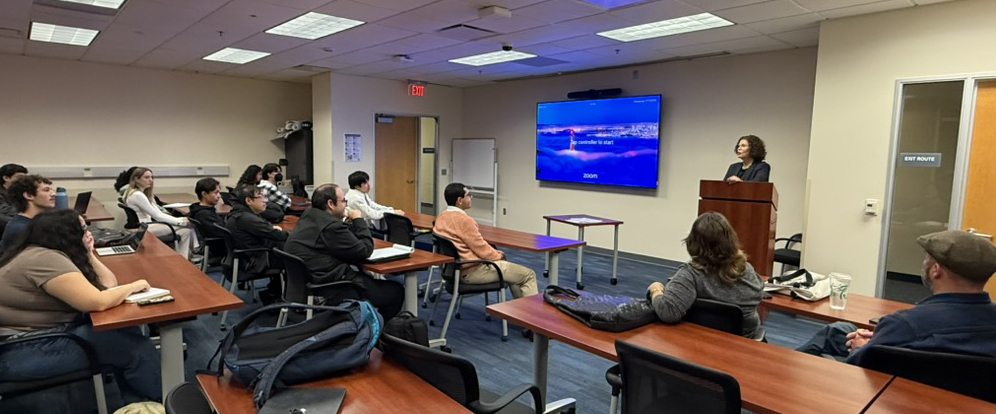
Among the guest lecturers in Professor Walter Nicholls' new "Community Scholars" class are former Long Beach City Council member Jeannine Pearce, above, and UNITE HERE Local 11 Co-President Ada Briceño, below.
New course enlists local labor leaders to help chart county’s political shift
A unique course being offered this quarter allows UC Irvine students to examine Orange County’s evolution from conservative “Reagan Country” to “a center for robust labor and community organizing” — with union organizers and community activists who helped make change happen.
Taught by Department of Urban Planning & Public Policy Chair, UC Irvine Labor Center Faculty Director and Professor Walter Nicholls, “UPPP 275: Community Scholars: Learning ‘Power Mapping’ through Orange County’s Worker Campaigns” meets Monday evenings. The instructor says the course is based on a class that started at UCLA in the 1990s, when members of nonprofits, labor unions and community groups with common interests were invited to speak to Bruin enrollees.
“We’ve introduced the concept a couple times in the past at UC Irvine, in 2013 and by Professor Virginia Parks in 2019-20,” says Nicholls. “Now that we launched the Labor Center, we want to make the course a permanent part of our curriculum that we’ll offer every year or every other year.”
The idea is to identify and examine the history of working-class movements in Southern California, particularly Orange County.
“Nothing has been written on this,” Nicholls says, “so we’ve invited speakers who are very active in the social justice movement to share their experiences, all through the lens of power.”
The first “Community Scholar” to speak to the class was UNITE HERE Local 11 Co-President Ada Briceño, who was frequently quoted by the press during 2023’s “Summer of Strikes” by hotel workers countywide. The former chair of Orange County’s Democratic Party, Briceño is currently seeking a state Assembly seat.
Joining Briceño on that first program titled “Introduction: OC’s Shifting Power Landscape” was former UNITE HERE organizer and Long Beach City Council member Jeannine Pearce, who is now an urban planning & public policy doctoral candidate.
The course’s second meeting, titled “Historical Foundations: From ‘Orange Curtain’ to Battleground,” brought Charles Barfield, general manager of the Orange County Employees Association, while the third class featured Derek Smith, political director of United Food & Commercial Workers (UFCW) International 324, who has been in the news lately for his take on cities imposing or considering bans on self-checkout lines in stores. Smith’s theme was “Worker-Led Power: Rank-and-File Organizing.”
Future speakers include UNITE HERE Local 11 Director Austin Lynch, UFCW 324 President Matt Bell, Harbor Institute Executive Director Carlos Perera and UC Irvine Labor Center Director Chris Duarte.
Key class readings range from chapters in the books L.A. Story: Immigrant Workers And the Future of the U.S. Labor Movement (Russell Sage Foundation 2006) by sociologist Ruth Milkman and Suburban Warriors: The Origins of the New American Right (Princeton University Press 2002) by historian Lisa McGirr to UCLA Labor Center reports “Orange County on the Cusp of Change” (2014) and “Helots No More: A Case Study of the Justice for Janitors Campaign in Los Angeles” (1998).
For an overview and more details about power mapping and the region’s labor social and political history, Nicholls delivers fact-based lectures, so no gap is left unfilled.
“One of the important things about politics in California is it was really center-right until 20 years ago,” he says. “We were a Trump state before Trump. It was strongly anti-immigrant.”
Nicholls agrees that changed mostly due to demographics, but he adds that following the passage of the anti-immigrant measure, Proposition 187 (“Save Our State”), in 1994, immigrant rights organizations and local unions shifted tact by developing strategies to enhance the political power of working-class immigrant communities. Unions like the Service Employees International Union (SEIU) with its path-breaking “Justice for Janitors” campaign, UNITE-HERE and its push to organize hotel workers, and the proliferation of new labor-friendly advocacy organizations like Los Angeles Alliance for a New Economy and the National Day Labor Organizing Network all adopted highly innovative worker-centered, immigrant empowering strategies that changed the political direction of the region and state. They pushed to organize the lowest income workers – such as janitors, hotel workers, fast-food workers and day laborers at places like Home Deport – who had long been ignored by national labor leaders.
Naturally, a large portion of those workers were also immigrants, so the unions adopted pro-immigrant stances as they campaigned to fill everything from city councils to state houses to the nation’s capital with like-minded representatives.
“It’s such a strange political world,” Nicholls says of our purple county. “We want our Community Scholars to localize that story. What was the balance of power? How did we change that power?”
He says about half the class is made up of students from worker unions and the other half are from the Master of Urban and Regional Planning (MURP) program.
“They love it,” Nicholls says, “and I love it, too.”
— Matt Coker
Features